

Tron: Ares
The grid in the real world; forget doom scrolling, programs can defy physics and wreck your world … in just 29 minutes.

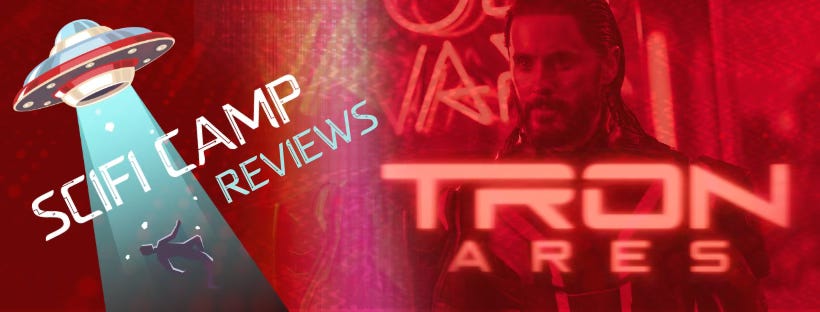
Welcome back to the Grid, User.
TRON has always been the cool friend who speaks in synth and silhouette. Ares asks a better question: what happens when that friend shows up on your street and starts bending physics where you live? This review is spoiler‑light, vibe‑forward, and aimed at readers who love the franchise but also want to know if the code finally compiles into a story.
The Good
Ares has a pulse. I went in expecting a cardboard baddie and got a redemption arc with teeth. Jared Leto’s Ares starts as a weaponized directive and edges toward personhood, not with speeches but with choices that cost him. When the movie locks onto that spine: purpose first, identity second. It finally remembers that TRON works when rules make worlds and breaking those rules makes story.
The vibe finally meets the idea. TRON (1982) gave us the base; Legacy (2010) turned it into a neon fueled question of life. Ares brings the world into our space.
The action isn’t confined to the Grid anymore; it leaks into streets, hangars, and boardrooms. That 80s‑era Grid callback (crisp vector lines framing a modern, flesh‑and‑blood Ares) lands as both nostalgia and thesis: the past is still running in the background, but the “executable” has changed.
Action you can read. Lightcycles slice, discs snap, and there’s a flying behemoth in the real world that absolutely rules. The geography is legible and kinetic instead of blender soup, and for once the light‑trail isn’t just pretty; it’s tactical.
A cleaner villain stack. Evan Peters’s Julian Dillinger has the sort of smirk you want to see get slapped (which he does). The movie doesn’t muddy him with both‑sides moral math; he’s greedy, entitled, and cowardice in a bespoke hoodie.
Jodie Turner‑Smith’s Athena, an elegantly lethal lieutenant, lets the film keep a live threat even as Ares turns. It’s smart architecture, and she’s an unrelenting force to be reckoned with.
The sound that stays out of the way. If Daft Punk’s Legacy score was a poor-man’s extended album, Nine Inch Nails builds an industrial sound thats equally good if you’re a fan of them or not. It churns more than it anthems, which means it supports the storytelling instead of swallowing it. If you’re a NIN fan you’ll smile; if you’re not (like me), you won’t be dragged out of the movie by a concept album (like Daft Punk did).
The Bad
Nostalgia, applied like a skin. Some callbacks do real work; others feel like UI overlays. The film knows we love the glow and occasionally can’t resist saying, “remember this?” instead of “watch this matter.” When it integrates the past (looking at you 80s Grid gag, and the bit) it sings. When it just samples, it hums.
TRON has always been more idea‑first than human‑first, but a little more texture would have helped the scenes where nobody’s derezzing.
The boy toy bit. Greta Lee’s Eve Kim has a boy toy running with her. Arturo Castro plays Seth Flores, said boy toy, and I truly couldn’t figure out if he was her boy friend or sub? Either way, he leans too goofy in a way that jars against the otherwise disciplined tone. He’s not ruinous, just tonally off.
The Ugly
Character headroom left on the table. Greta Lee’s Eve Kim is compelling by presence alone, but the script keeps her in the “obvious arc” lane when she could have been the franchise’s most interesting human since Flynn. Give her messier choices and give her more agency. The dead sister she has to live up to and fulfill her work was just a little too tried and worn.
Exposition that mistakes jargon for theme. When the movie explains itself, it occasionally forgets to argue for itself. The film’s best moments show us ethics in motion — we didn’t need a Jurassic World or Short Circuit style military showcase. Womp womp.
Tropes, Callbacks, and Why They Work Here
TRON has always been a closed‑system. A human wanders into a rule‑bound realm, discovers the theology beneath the interface, and fights a duel that doubles as a sermon. Ares inverts that pilgrimage: the emissary steps out of the temple. That’s not just cool (though it is cool) it’s a shift in what the franchise is for. The grid isn’t a metaphor anymore; it’s a material hazard. The 29‑minute limit becomes a plot clock and an existential price tag.
We get tasteful deep cuts. The 80’s Grid insert is a flex that justifies itself. Jeff Bridges’s spectral presence reminds us that Flynn is the saga’s ghost in the machine. And the mid‑credits stinger is pure, giddy franchise logic: the Dillinger line embracing the mask we all expected it to wear. That’s fan service that services the story.
As for the ISO subplot from Legacy: Ares largely shelves it. Instead of the miracle of spontaneous life, we’re arguing custody and consent — what it means when designed beings want to be human, and what humans are willing to risk to keep control. That’s a cleaner, sharper conflict for 2025.
How It Stacks Up in the Trilogy
The original is still the core concept — spare, weird, foundational. Legacy is a mood board with lore for days and a score that plays to a specific fan service. Ares is the first to make the real world the arena, which gives it stakes you can touch. For me right now: Ares > Tron > Legacy. The classic has the vibes; Ares has the better story; Legacy remains an interesting talking point.
Mid Credit Spoilers
Mid‑credits, we check in on Julian Dillinger. He dodges handcuffs by escaping into his own Grid and, in a delicious nod, claims a red‑grey identity disc that blossoms into Sark’s armor (the Games Master built by his grandfather’s code). It’s not just a wink; it’s a promise that the franchise finally found a recurring antagonist it knows how to use… if we get a Tron 4.
Final Verdict
Ares is the first TRON where the glow means something practical: the Grid can come here. It’s redemption over nihilism, purpose over programming, and a reminder that our creations always ask for more than we designed them to want. It’s also a movie you can simply enjoy. Go see it. The original still hums like a classic cabinet, but this one tells a stronger story.
Grade: B
Join the Thread
Your move, Programs: Did Ares earn its callbacks or just reskin them? Where did the score actually lift a scene for you), and which moment made you realize the Grid in the real world raises the stakes for this series? Drop your takes below!
I found Legacy compelling, if imperfect. It felt like it had built a step toward what Ares MIGHT be about, but the creators of Ares just threw out the continuation in favor of telling their 'own story'. I have yet to watch the film, so I can't speak to the quality of that decision, but I was deeply disappointed that we didn't get the continuation of the Legacy storyline.
In that regard, I find it hard to see these films as a trilogy. Will give it a watch, reserve my judgment, and enjoy what is there to be enjoyed. Thanks for the review!