

How Aliens Reflect our Prejudices
or, Science fiction's most optimistic war story

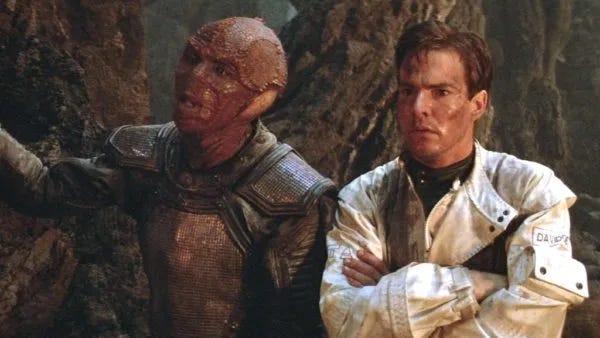
One of my favorite recurring science fiction stories doesn’t involve space battles, galaxy-spanning empires, or the bureaucratic numbering of assets.
It’s the story of two people who absolutely hate each other.
More specifically, it’s the story of two people who are supposed to hate each other.
The setup is simple: two enemies become stranded together and ultimately must survive together. It doesn’t matter the specifics on why they hate each other (which is also a very human thing); sometimes they are on opposing sides in a war, sometimes they are different species, or different cultures, or different ideaologies — whatever. You get the point. They are enemies because they’re supposed to be enemies, not because of a personal vendetta or score.
The need to survive overcomes their prejudices.
The trope is commonly called the “Enemy Mine Trope,” named after Barry B. Longyear’s (what a name!) 1979 novella and the 1985 film adaptation starring Dennis Quaid and Louis Gossett Jr. While the concept existed before that, 1968’s Hell in the Pacific is an obvious predecessor, Enemy Mine became so influential that it eventually lent its name to the entire storytelling device — and it’s easy to see why.
This post is a part of SciFi Camp’s 🛸 month-long theme,
all about ALIENS. 👽
At its core, the trope is one of the most optimistic ideas science fiction has ever produced. It argues (accurately) that hatred is learned and that the “other” becomes a lot less frightening once you actually get to know them. And that shared hardship can build bridges that politics, propaganda, and even war cannot.
That’s a very science fiction idea.
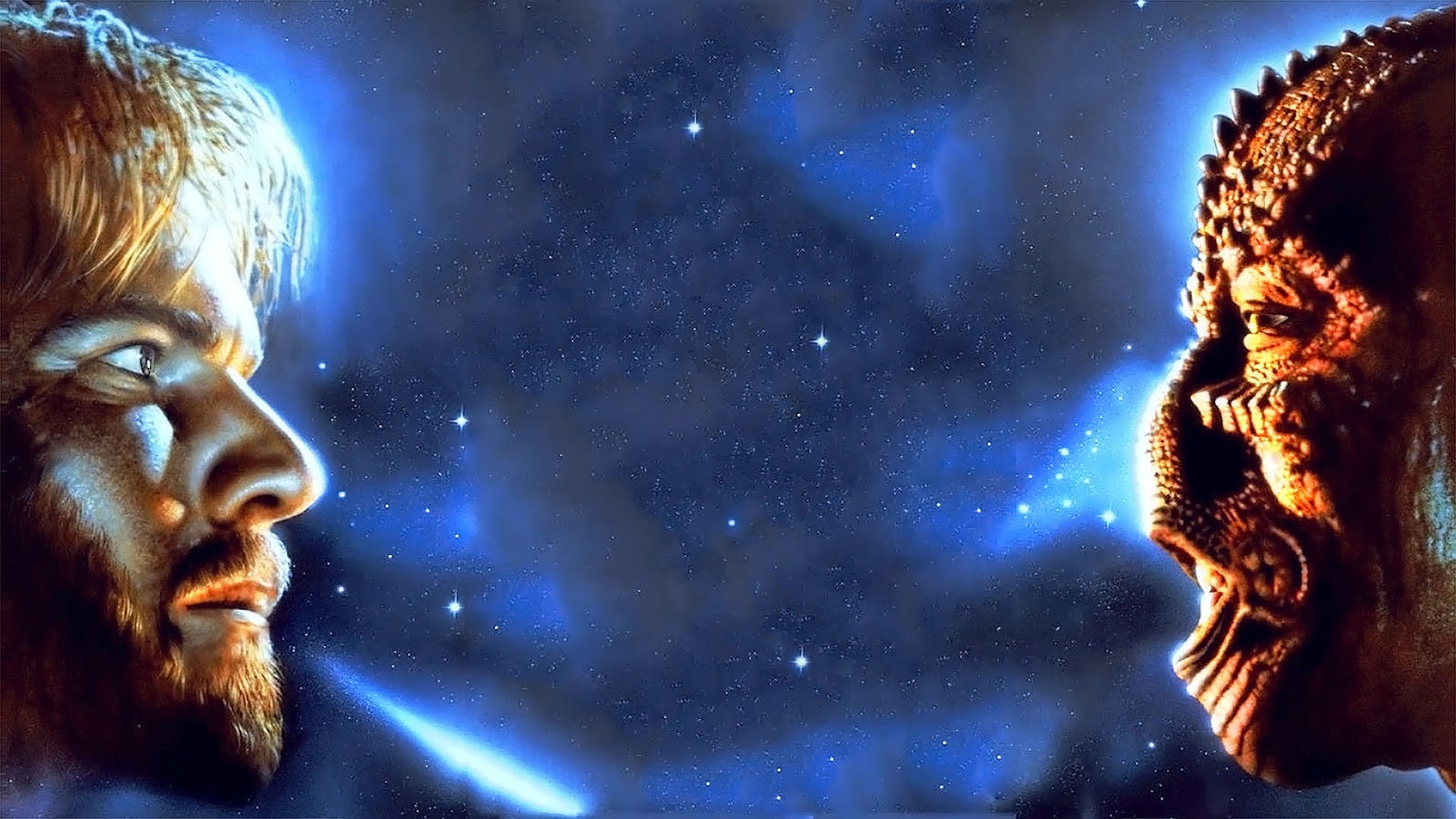
Enemy Mine (1985)
If you’ve never seen Enemy Mine, I’m going to spoil it for you (and by way of spoilage, all the TV episodes in the trope, lol).
Human pilot Willis Davidge and Drac warrior Jeriba Shigan are enemies in an interstellar war. After shooting each other down, they crash on a hostile planet where neither can survive alone.
The early portions of the film are exactly what you’d expect. They distrust each other, take each other as prisoners, and argue over who is right in the war. They insult one another’s culture and lean into the prejudices they were born into that were stoked by propaganda.
But then something interesting happens; they start talking. And it’s important to note, they are talking to each other, not debating, not negotiating — just talking.
Davidge learns about Drac religion, family, and history. Jeriba learns that humans are more than the caricatures he’s been taught to hate. Over time, the enemy becomes a companion, then a friend, and eventually something closer to family.
What makes the story particularly powerful is that it doesn’t end once survival is achieved. By the conclusion, Davidge finds himself defending the child of his former enemy (Drac had a child during their survival) against members of his own species. For Davidge, the conflict changes.
And we, the viewers, learn that the hostile planet was never the real challenge; the real challenge was overcoming prejudice.
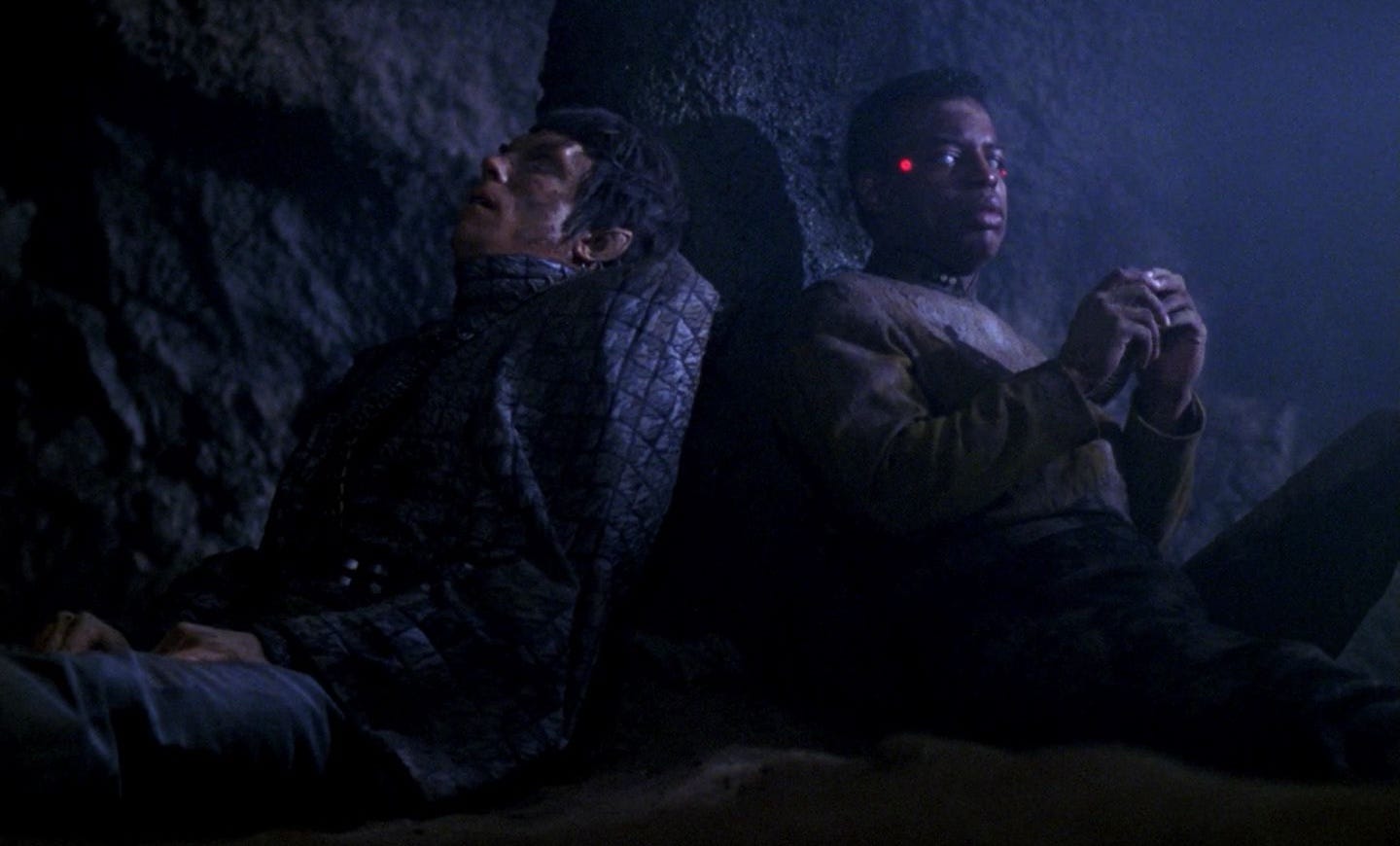
Star Trek: The Next Generation, S3E7 “The Enemy”
If any franchise was destined to embrace the Enemy Mine trope, it was Star Trek.
“The Enemy” strands Geordi La Forge on the storm-ravaged world of Galorndon Core alongside a wounded Romulan soldier. The Federation and the Romulan Star Empire have spent decades distrusting one another. Neither man has any reason to believe the other deserves trust.
Yet, like with Davidge and Drac, survival demands cooperation.
What I love about this episode is that it demonstrates how quickly individuals can move past political divisions when circumstances force them to rely on one another. While diplomats and admirals spend decades arguing, two stranded people make progress within hours (though this is condensed for Star Trek’s sake).
The episode also cleverly contrasts personal understanding with institutional hatred. Even as Geordi and the Romulan begin to find common ground, the broader conflict between their governments continues. It’s a reminder that understanding another person is often easier than changing an entire system.
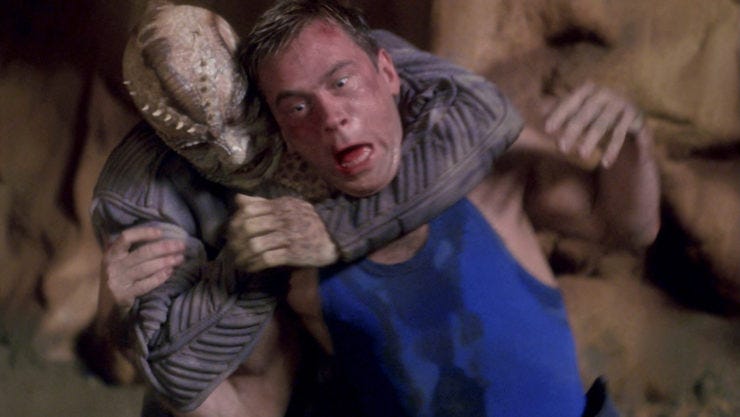
Star Trek: Enterprise, S2E13 “Dawn”
If “The Enemy” is Star Trek’s version of the trope, “Dawn” is Star Trek’s version of Enemy Mine, the film.
Commander Trip Tucker crash-lands on an inhospitable world alongside an alien from a species that has recently come into conflict with humanity. Communication is difficult. Trust is nearly impossible. The environment is actively trying to kill them both.
Sound familiar? I think I even saw a Zerki...
The episode follows the classic formula almost beat-for-beat, which really isn’t surprising because the formula itself is incredible.
By forcing both characters into a situation where cooperation becomes necessary, the story reveals how many assumptions each side has made about the other. Much of their hatred turns out to be based on stories rather than experience.
That’s a recurring theme in Enemy Mine stories: enemies don’t actually know each other.
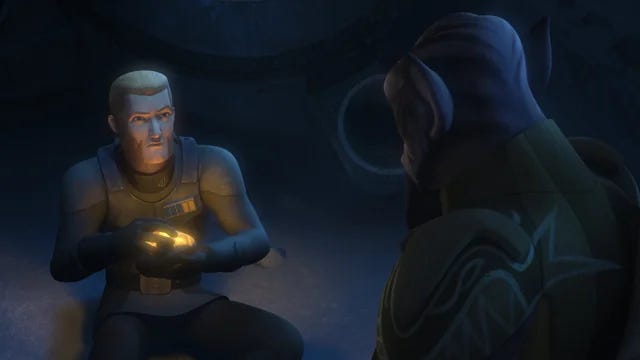
Star Wars Rebels, S2E17 “The Honorable Ones”
Rebel fighter Garazeb “Zeb” Orrelios and Imperial Security Bureau Agent Kallus find themselves stranded together on an icy moon after a battle. Both have spent years viewing the other as the embodiment of everything wrong with the galaxy. Zeb sees Kallus as an Imperial oppressor, and Kallus sees Zeb as a dangerous rebel.
In this case, unlike the other examples, neither character is entirely wrong. Zeb is dangerous and has a body count to prove it. Kallus is an officer of the oppressive regime. These two knew of each other before they were put in this situation.
Yet as the episode progresses, both men begin to understand the experiences that shaped the other. The result is one of the most nuanced character stories in all of Star Wars. What’s particularly interesting is that the episode doesn’t magically solve every disagreement. They still serve opposing causes. They still have genuine ideological differences. But they stop seeing each other as monsters.
A few interesting asides…
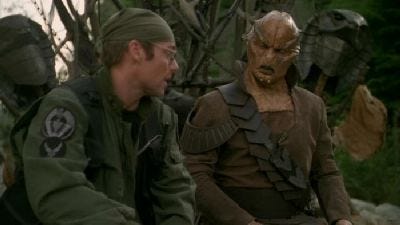
Stargate SG-1, S7E7 “Enemy Mine”
What makes Stargate’s take on the trope (as the name is a play on the trope and on the fact that they want an actual mine) interesting is that it isn’t really about two enemies trapped together. Instead, it asks whether an enemy race should continue to be treated as an enemy at all.
In “Enemy Mine,” Stargate Command discovers a valuable naquadah deposit that Earth desperately wants to mine. The problem is that the planet is already inhabited by a tribe of Unas, the species many humans still view as primitive animals. Daniel Jackson brings back his old Unas friend Chaka to help negotiate, only to discover that the real conflict isn’t between humans and aliens. It’s between people who see the Unas as intelligent beings and people who see them as obstacles standing on valuable resources (aka American expansionism and Native American lands).
Unlike the classic Enemy Mine formula, nobody is stranded, and the planet isn’t trying to kill them. Yet the heart of the story is identical. Daniel’s greatest challenge is convincing his own people that the “enemy” they’ve been fighting is neither a monster nor a resource to be exploited, but a culture deserving the same respect humans would demand for themselves. By the end, the episode transforms what began as a mining dispute into a question of personhood and prejudice.
Side note, Michael Rooker’s Major Lorne is a real backpfeifengesicht, as the Germans would say.
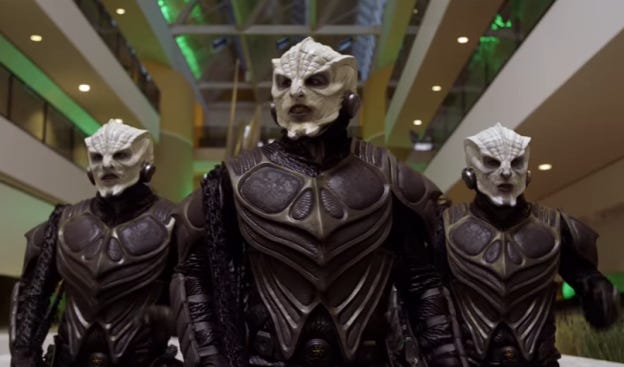
The Orville — The Union and the Krill
While The Orville doesn’t have a single episode that perfectly recreates the Enemy Mine formula, the show’s relationship between the Planetary Union and the Krill repeatedly explores the same themes. The Krill are initially presented as religious extremists and implacable enemies of the Union, with both sides viewing the other as fundamentally dangerous and morally inferior. Over time, however, characters on both sides are forced into situations where cooperation becomes necessary.
The clearest example comes in Season 2, Episode 6, “A Happy Refrain,” and later in the larger Krill story arcs, where personal relationships begin to challenge deeply held assumptions. Much like the best Enemy Mine stories, the conflict isn’t resolved because one side wins. It’s resolved because individuals finally spend enough time with one another to realize the stereotypes they’ve inherited are incomplete. The Orville repeatedly argues that understanding another culture doesn’t require agreeing with it, but it does require seeing its people as people rather than caricatures.
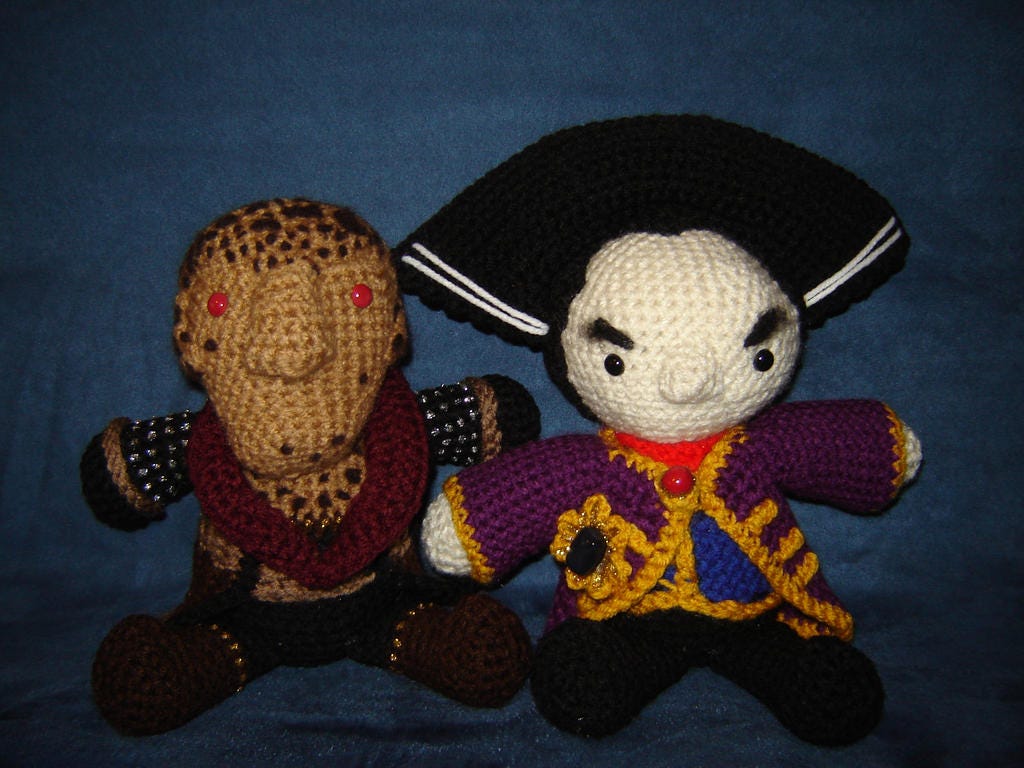
Babylon 5 — Londo Mollari and G’Kar
If Enemy Mine is the definitive short-form version of the self-titled trope, Babylon 5 may be its greatest long-form expression.
When the series begins, Centauri ambassador Londo Mollari and Narn ambassador G’Kar genuinely despise one another. Their people have centuries of history filled with conquest, occupation, terrorism, retaliation, and bitterness. They spend the early seasons trading insults, political schemes, and occasionally outright threats. Neither man sees the other as anything more than a representative of an enemy civilization.
What makes Babylon 5 remarkable is that creator J. Michael Straczynski spends five seasons dismantling those assumptions. As both men experience loss, failure, guilt, and redemption, they slowly come to recognize something of themselves in the other. By the end of the series, they have not forgotten the atrocities committed by either side, nor have they suddenly become best friends. Instead, they achieve something far more interesting: mutual understanding.
Unlike most Enemy Mine stories, there is no hostile planet forcing cooperation and no immediate survival crisis. The struggle unfolds over years rather than days. Yet the core message remains the same. The greatest barriers between enemies are often not biology, language, or politics, but the stories they tell themselves about one another. Few science fiction series have explored that idea with the depth and patience of Babylon 5.
Why Science Fiction Keeps Returning to This Story?
The reason this trope appears over and over again is because it allows science fiction to explore prejudice in its purest form. A war story can place two soldiers from different nations together; science fiction can place two entirely different species together.
The genre can exaggerate differences until they seem impossible to overcome: different biology, different cultures, different histories, different ways of thinking. Just plain different.
Then it asks a simple question: What if they’re not as different as they seem? The answer is rarely that everyone suddenly agrees; the answer is usually that understanding becomes possible. And that’s what makes these stories endure.
It’s the lesson we still need to learn today. And. Some. How. We. Don’t.
In a genre filled with apocalyptic threats, unstoppable empires, and planet-destroying weapons, the Enemy Mine story remains surprisingly hopeful. It suggests that the greatest divide isn’t between humans and aliens, or between rival governments, or even between opposing sides of a war. The greatest divide is ignorance.
And the cure is often as simple as being forced to share a campfire with someone you thought you hated.
That’s why science fiction keeps telling this story, because deep down, we want to believe that if two enemies can survive together long enough, they might eventually discover they were never truly enemies at all.
…the cure is often as simple as being forced to share a campfire with someone you thought you hated.
Your Thoughts…
What is your favorite example of the
Enemy Mine Trope?
What about examples from literature?
All the ones I can think of are TV shows…
And, since I haven’t watched it yet, is there a Farscape episode on this theme I’ve missed? You tell me!
Community Note from William R. Crichton:
Farscape has this a lot.
Crichton and Scorpius repeatedly.
Crichton and Harvey repeatedly.
Individual episodes with other characters:
- PK Tech Girl
- Liars, Guns, and Money
https://scificamp.substack.com/p/the-enemy-mine-trope/comment/273500654
Farscape has this a lot.
Crichton and Scorpius repeatedly.
Crichton and Harvey repeatedly.
Individual episodes with other characters:
- PK Tech Girl
- Liars, Guns, and Money