

Dehumanizing the Alien: How District 9 Mirrors Our Darkest History

All month long, SciFi Camp 🛸 will be tackling the fascinating subjects of cow abductions and the topic of many a recent US government info dump: ALIENS. 👽
I want to start this carefully, because this is one of those topics where the easiest way to make a point is also the easiest way to make a mess.
I do not have a personal family history with Juneteenth. I am a white guy writing about science fiction on the internet, which means I am not going to be pretending this holiday belongs to me in some deeply personal way. It does not. But I do think Juneteenth is worth honoring, thinking about, and learning from. And since June at SciFi Camp is about aliens, otherness, contact, etc, I thought maybe we could look at one movie in particular: District 9.
This is not because District 9 is “about Juneteenth” – it isn’t. Let’s be clear, Juneteenth is real American history, District 9 is a grimy, angry, bug-alien sci-fi film set in Johannesburg, South Africa. The story is ripe with apartheid imagery, xenophobia, corporate cruelty, and Cronenberg-style body horror. Those are not interchangeable things, and flattening them together would be both lazy and disrespectful.
But science fiction is often at its best when it gives us a strange angle on a real moral problem. And District 9 gives us a brutal one: what happens when a society decides that some people are not really people?
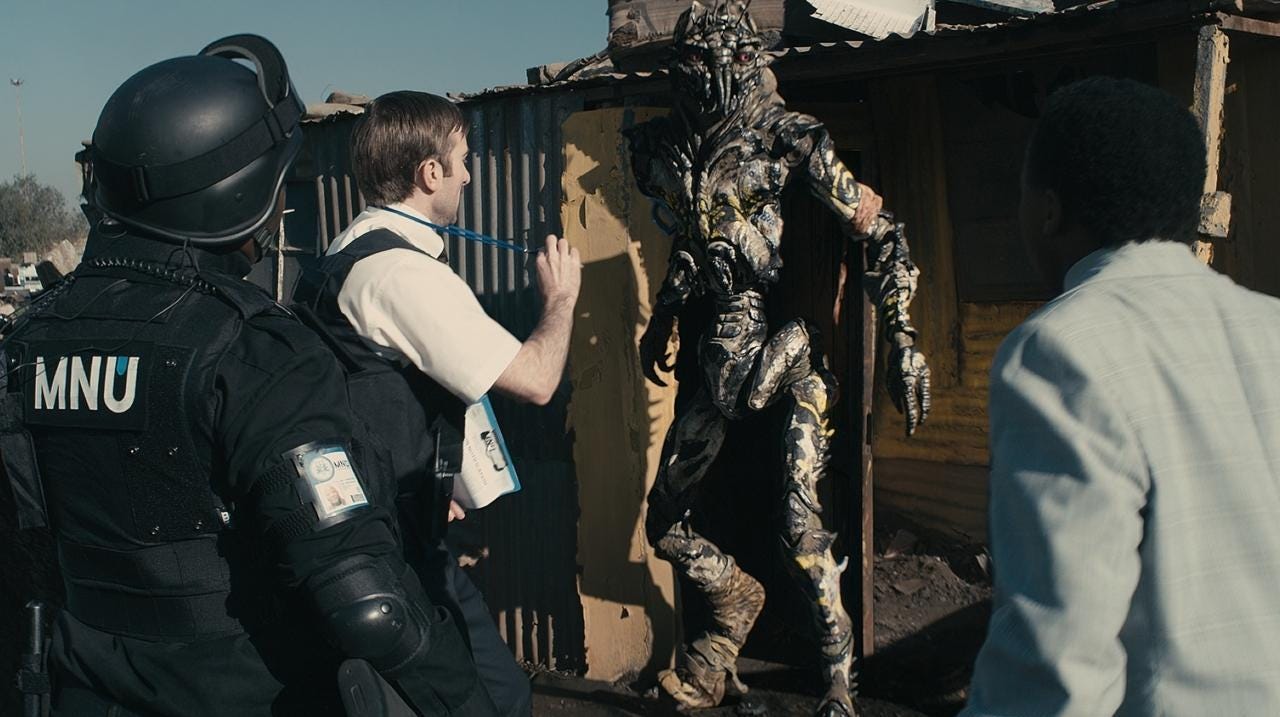
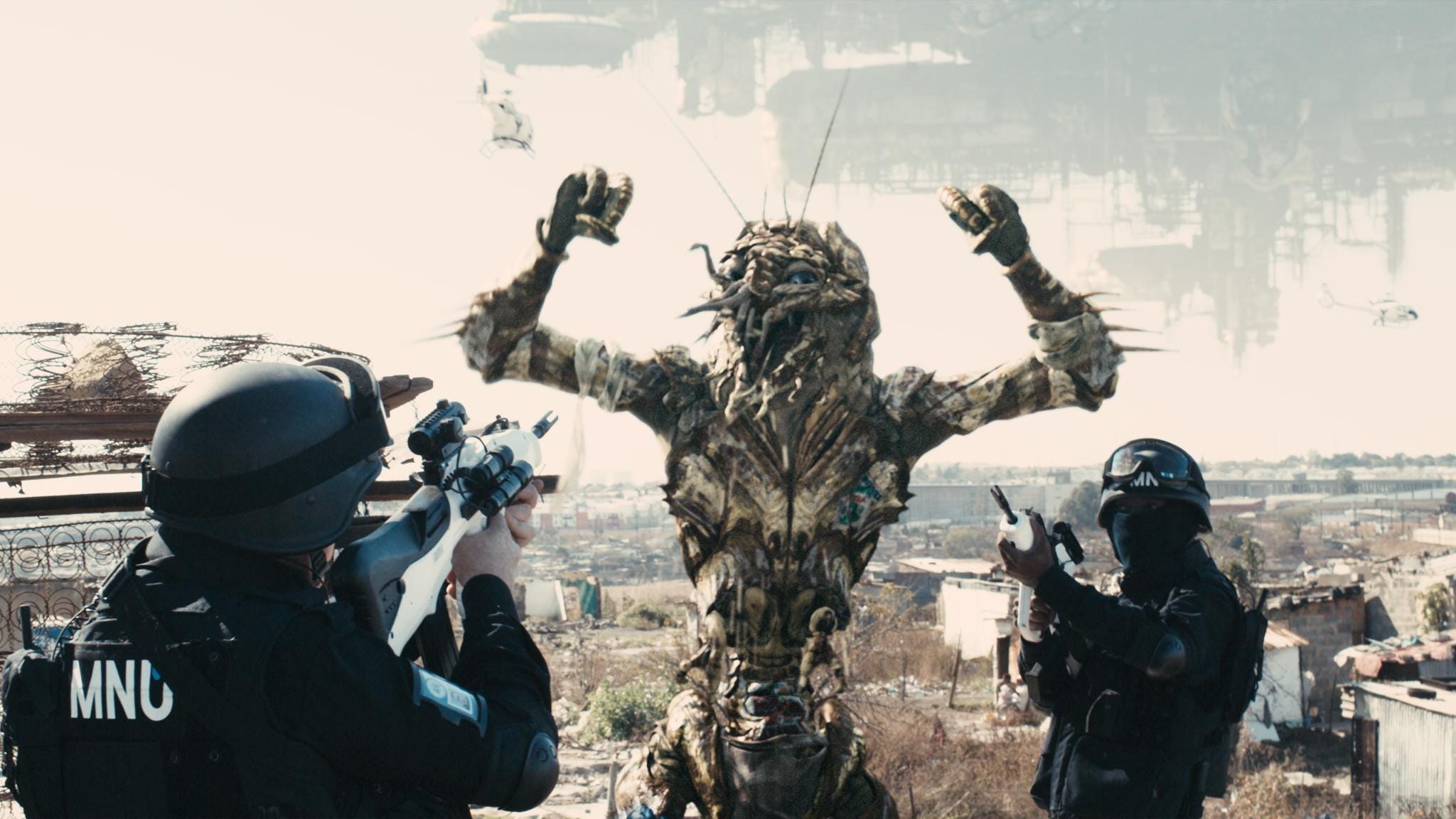
The aliens in District 9 (derogatorily called “prawns”) arrive on Earth as refugees (a twist on the alien invasion trope). Their ship appears over Johannesburg, and what humanity finds inside is not an invading army. It is a population that is sick, hungry, stranded, and vulnerable.
Humanity’s response is not exactly our finest hour.
At first, the aliens are treated as a problem to be managed… then as a population to be contained… then as a political inconvenience… then as a corporate resource… then as test subjects… then as vermin…
The genius and the nastiness of District 9 is that it does not show oppression beginning with a giant villain speech. Nobody stands in front of a flag and announces, “Today we begin our descent into moral rot.” Instead, it happens through forms, policies, and bureaucracy. And that, really, is where District 9 becomes such a useful science fiction mirror.
Because dehumanization rarely comes blazing in, it usually creeps in, calling itself safety, or order, or efficiency. It uses economics, traditions, and law to claw its way into our lives, rooting before we even know it’s there. Wikus van de Merwe is such an effective character because he is not introduced as a grand monster; he’s just a petty bureaucrat doing his job. He’s a guy who seems more awkward than evil, more annoying than dangerous. He smiles as he serves eviction notices and jokes as he destroys alien eggs. He does not initially see himself as cruel, which is part of what makes him so grotesque. He might not be the person who built the machine, but he’s one of the people who are keeping it running.
A lot of science fiction oppression stories are built around obvious tyrants: emperors, dictators, evil admirals, megacorporate overlords, and various bald men … that was originally a typo of ‘bad men,’ but also, a lot of villains are bald men, and I love those stories. Give me a sneering space tyrant and a hero with a questionable plan any day of the week. But District 9 is more uncomfortable because the horror is ordinary, it’s administrative. It is neighbors on the news complaining about the aliens, while a corporation manipulates alien biology as we do with animals — ultimately, it’s the public accepting a camp (or district) because the camp is somewhere else, not where they are.
That is the part that connects, carefully but meaningfully, to the themes Juneteenth asks us to sit with.
Juneteenth is a celebration of freedom, but it is also a reminder that freedom was delayed. The Emancipation Proclamation had been issued more than two years earlier, and the legal reality and the lived reality were not in sync. Freedom existed on paper, but had never arrived for the enslaved people in Galveston, Texas.
Science fiction returns to that gap over and over again: the space between being declared free and being treated as free. The space between personhood as a concept and personhood as a practice. The space between a society congratulating itself on its values and actually extending those values to the people it climbed over to get them.
In District 9, the aliens are not enslaved in the specific historical sense that Juneteenth remembers, but they are trapped inside a system that depends on denying their dignity. They are named by their usefulness, their inconvenience, and their disgust value. They are spoken about, moved around, experimented on, and threatened by people who rarely bother asking what they want.
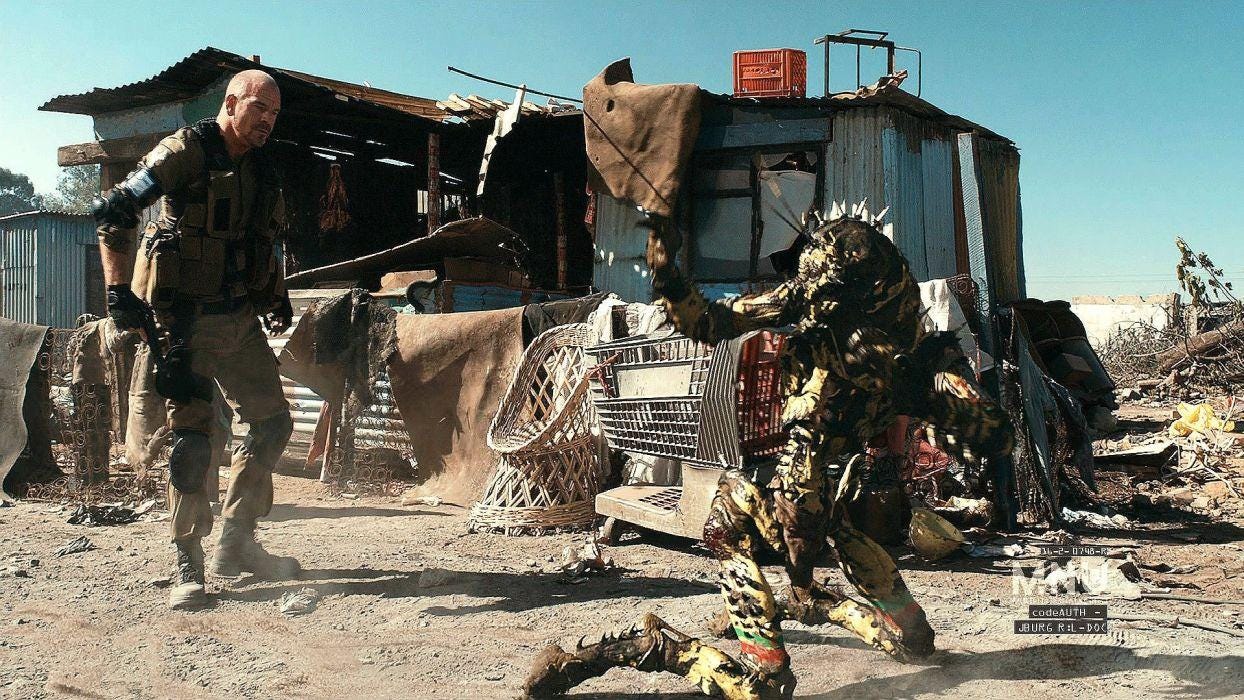
And then the movie twists the knife. Wikus only begins to recognize the aliens’ personhood when he starts becoming one of them. This is one of the most interesting and frustrating parts of the film. On one hand, it gives the story its body-horror engine. Wikus is forced into empathy because the border between “us” and “them” is literally collapsing inside his own body. He can no longer pretend the category is clean because he no longer fits inside it. On the other hand, it also says something pretty bleak about human beings: sometimes, we do not care about cruelty until it threatens to include us.
That is not exactly a cheerful Juneteenth message, I know, but science fiction has never been good at leaving well enough alone. It pokes the bruise and has the audacity to ask the rude questions. It asks, “Okay, but what if the monster is not the alien? What if the monster is the system we built around the alien?”
And that’s why District 9 still hits the point home.
The aliens are visually strange and hard for the humans to understand. They do things that humanity finds weird or that make them recoil. They like things we consider refuse or below us (such as a taste for cat food?). They are different from so many other sentient aliens in SciFi (I make the distinction of sentience as the Xenomorph or similar creatures fall outside of the conversation). For example, the District 9 aliens are not E.T. with big, damp eyes and a glowing finger. They are not Vulcans arriving with clean robes and a working knowledge of diplomacy. They are difficult, desperate, traumatized, and alien. And that is the point.
The test of personhood is not whether someone is easy for us to sympathize with. It is not whether they are charming. It is not whether they speak in a way we recognize, live in a way we approve of, or look like someone we already know how to love.
If your moral system only works when the person in front of you is palatable, it is not much of a moral system.
That is where science fiction can be useful on a day like Juneteenth. Not as a replacement for history, and not as a way for those of us without a personal Juneteenth story to center ourselves, but as a way to examine the stories we tell about freedom. Because “freedom” is one of those words that everybody likes and sews on their jackets and slaps on their bumpers… until it looks a little different to them. Then they have a choice: do they extend the freedom to all, or do they hold it close for just themselves, make it a statue, a speech, a holiday, a nice idea with a flag behind it, but never shared beyond their tribe?
See, actual freedom asks harder questions. Who has power? Who gets protected? Who gets believed? Who gets moved? Who gets watched? Who gets called dangerous? Who gets told to be patient? Who gets told their suffering is too complicated?
District 9 is not subtle about those questions, and, frankly, subtlety would probably be wasted here. It is a movie about aliens in a slum being evicted by a weapons corporation. That’s about as clear a message as if Neill Blomkamp had just written it on the poster.
If your moral system only works when the person in front of you is palatable, it is not much of a moral system.
Juneteenth reminds us that freedom announced is not always freedom received. District 9 reminds us that societies are very good at creating categories of people they do not have to feel guilty about harming. Put those ideas near each other, and you get a useful, uncomfortable question: Who are we still waiting to fully recognize?
That is not a question I ask as someone claiming special ownership of Juneteenth. I ask as someone who loves science fiction and thinks the genre matters most when it refuses to let us escape into the future without bringing our history with us. Listen, aliens are fun. Spaceships are fun. Weird weapons that explode people into goo are, in the very specific context of science fiction cinema, also fun. But the best alien stories are rarely just about aliens… they’re about us.
They are about what we do when something unfamiliar arrives over (or in) our city. They are about who we fear, who we exploit, who we cage, and who we decide does not count. They are about whether our idea of freedom is big enough to include people we do not understand. That seems like a fitting thing to think about on Juneteenth. Not because District 9 explains the holiday (it doesn’t), but because Juneteenth asks us to remember that freedom delayed is a wound, freedom denied is a crime, and freedom celebrated should never become freedom completed.
The future is not free until everyone gets there.
District 9 is one of my favorite movies. How are low-budget sci-fi movies just consistently so much better than overproduced blockbusters?
I don't remember the movie too well, but what I remember it was good and your take is reasonable.
I think it does kind of present an easy test, though. The aliens are largely peaceful and can be easily housed without much strain. The human response is one of fear and bigotry, which, to be fair, we've more than shown we're liable towards.
But it'd be interesting to see a work that explores the appropriate boundaries of compassion, as difficult and fraught as that concept is.
What if the aliens are less like oppressed refugees, and more like Conquistadors, siding with one nation against another? OR what if they require scarce resources or enough space to actually cost us something? What if we have to risk offending some other galactic power by taking them in?
Basically, where is the border line between loyalty to our fellow humans and loyalty to an outsider who needs help?
Of course, the problem with such a question is it quickly becomes about current political questions. But I think it's interesting in its own right. *Do* relations with a genuinely alien people mirror those with another human nation? Why shouldn't the one planet we're on and adapted to be reserved for us? Is there a moral space between self-sacrifice and aggressive imperialism?
In practice the *most* moral choice is probably to ignore the demagogues and search carefully for a mutually beneficial solution. Which if course is probably impossible in practice, due to that fear and bigotry explored in this movie. But even without it there remains difficult questions.
(Actually, this has been done in series I need to read, like Three Body Problem and The Mote in God's Eye, and maybe Babylon 5?)